

Trip Fact
There are some important facts about Langtang Valley
-
Max Altitude 4,773m/15,659ft
-
Difficulty Moderate
-
Duration 5-6 days walking
-
Trip Profile Langtang Valley, Langtang Region
-
Type Trekking
-
Accommodation 3 star hotel in Kathmandu and tea house during the trek
-
Meal plan All meals included (B/L/D)
Langtang Valley Trek Overview
The magnificent Langtang region is perfect for those seeking nature in abundance. Like all trekking regions in Nepal, Langtang is growing more popular, yet it’s less visited than the busy Everest and Annapurna regions. The Langtang Valley trek in Nepal ticks so many boxes! Being fairly short, it’s perfect for beginners or those with less time for trekking.
Trek through forests rich with flora and fauna including masses of rhododendrons (in full bloom in Spring), and spot exotic birds and monkeys! Relish the magic moment when you leave the jungle and step into the wide open space of the beautiful Langtang Valley. Then witness the enormity of the Himalaya when you spot Langtang Lirung (7,234m/23,711ft) for the first time! The highlight of our trek – we summit Kyanjin-Ri (4,773m/15,659ft) and enjoy one of the most spectacular 360° views!
The Langtang Valley trek includes some long walking days and steep ascents. So, we recommend you have a moderate level of fitness to do this trek. Understanding Langtang trek difficulty helps trekkers prepare for gradual altitude gain and long walking days. The trek reaches high-altitude places like Kyanjin Gompa. Although it is easier and shorter than the Everest Base Camp Trek, proper fitness and acclimatization are still important for a safe and enjoyable trekking experience.
Team Nepalorama trekked in the Langtang Valley in January 2018 – read our blog to find out more about this stunning trek. Or, read our clients’ recommendation from September 2018.
Updated Route Information for Langtang Valley Trek
Planning the Langtang Valley Trek? Due to changes in road access following the August 2026 flash flood, the trekking approach may use an alternative route via Thulo Syabru instead of the traditional access through Syabrubesi.
Our Langtang Valley Trek package can be arranged according to the latest local road and trail conditions. The updated route still takes you through the beautiful Langtang region, including Lama Hotel, Langtang Village, Kyanjin Gompa, Kyanjin Ri, and Tserko Ri.
For the latest information about access, route changes, and trekking conditions, read our detailed guide:
The guide explains the alternative route via Thulo Syabru, current access information, and what trekkers should know before starting the Langtang Valley Trek.
Ready to plan your trek? Explore our Langtang Valley Trek package for the detailed itinerary, cost, inclusions, difficulty, and booking information.
Trekking to Kyanjin Gumba
After an overnight stay in a comfortable 3* Kathmandu hotel, we travel to Langtang by tourist bus or private jeep. Both options take the best part of a day, with a jeep being slightly faster, safer and more comfortable. Our destination and the starting point of our trek is Syabrubesi, close to the Tibetan border. The river runs through this lovely town surrounded by steep mountains where Nepali and Tibetan people meet to do business.
We start our trek following the glacial blue waters of the holy Trisuli River flowing from Gosaikunda. We ascend gradually and sometimes steeply through stunning forests of rhododendrons (in full bloom in Spring). Spot grey langur monkeys playing in the trees, exotic birds and giant beehives clinging to the mountainside. After trekking through the jungle, when you step out into the beautiful Langtang Valley, the feeling of space is magical! The backdrop – Langtang Lirung (7,234m/23,711ft) is our destination! After three days of good walking we reach beautiful mountain settlement Kyanjin Gumba – our base for two nights as we rest and summit Kyanjin-Ri.
The Langtang Valley Trek is a moderate trek suitable for both beginners and experienced trekkers. Understanding Langtang trek difficulty helps trekkers prepare for gradual altitude gain and long walking days. The trek reaches high-altitude places like Kyanjin Gompa. Although it is easier and shorter than the Everest Base Camp Trek, proper fitness and acclimatization are still important for a safe and enjoyable trekking experience.
Summit Kyanjin-Ri (4,773m/15,659ft)
From Kyanjin Gumba, cast eyes on our summit – Kyanjin-Ri. We’ll climb steeply yet steadily for two to three hours watching the town of Kyanjin Gumba getting smaller and smaller. When you reach the summit, take a deep breath and feel the exhilaration as you take in the magnificent 360° view including a postcard perfect view of Langtang Lirung (7,234m/23,711ft). Colourful Tibetan prayer flags create the perfect frame for the many beautiful peaks that surround you.
Kathmandu
After a long drive back to Kathmandu, stay in Nepal a little longer and enjoy the capital. Kathmandu is home to seven UNESCO World Heritage Sites, so you’ll be sure to want to see some! Get more ideas about what to do in this Kathmandu Travel Guide.
Ask us about including a sightseeing tour in your itinerary and make sure you allow time to pick up souvenirs and gifts!
Why Langtang Valley Trek?
The Langtang Valley Trek is an ideal choice if you want a genuine Himalayan experience without the longer travel and crowds of Everest or Annapurna. Located close to Kathmandu, Langtang is easily accessible by road and offers spectacular views of Langtang Lirung (7234m), glaciers, alpine landscapes, and high mountain valleys. Along the trail, you can experience the warm hospitality and Tamang culture, visit Buddhist monasteries and villages, and explore the dramatic scenery of Langtang National Park. With its combination of mountain views, rich culture, glaciers, and fewer crowds, Langtang Valley is a rewarding short-to-moderate trek for travelers seeking an authentic Nepal trekking experience.
Langtang Valley Trek Altitude Chart

Langtang trek Itinerary Outline
| Day | Itinerary | Distance miles/km | Time(hr) | Altitude(m) |
| 1 | Arrive in Kathmandu | – | 1400m | |
| 2 | Drive to Syabrubesi | 75.8 miles/121km | 6-7 hr | 1460m |
| 3 | Trek Syabrubesi to LamaHotel | 6.8 miles/11km | 5-6 hr | 2470m |
| 4 | Trek Lama Hotel to Langtang | 7.5 miles/ 12km | 5-6 hr | 3430m |
| 5 | Langtang to Kyanjin Gumba | 3.7 miles / 6 km | 3-4 hr | 3870m |
| 6 | Summit Kyanjin-Ri | 2.5 miles/ 4 km | 4-5 hr | 4773m |
| 7 | Kyanjin Gumpa to Lama Hotel | 11.2 miles/ 18km | 6-7 hr | 2470m |
| 8 | Lama Hotel to Syabrubesi | 6.8 miles/ 11km | 5-6 hr | 1460m |
| 9 | Syabrubesi to Kathmandu | 75.8 miles /121 km | 6-7 hr | 1400m |
| 10 | Depature | – | – | – |
Langtang Valley Trek Route
Kathmandu → Syabrubesi → Bhote Koshi River Valley → Bamboo → Rimche → Lama Hotel → Ghodatabela → Thangsyap → Langtang Village → Mundu → Kyanjin Gompa → Kyanjin Ri / Tserko Ri (Viewpoints) → Return via same route to Syabrubesi → Kathmandu
The Langtang Valley Trek route takes you from the lower Himalayan foothills into a spectacular high-altitude valley surrounded by snow-capped mountains. The trail combines dense forests, Tamang villages, Buddhist culture, glaciers, and dramatic Himalayan scenery.
Syabrubesi
Syabrubesi is the starting point of the Langtang Valley Trek and the main gateway to Langtang National Park. From here, the trail follows the Langtang River through forests and mountain villages.
Lama Hotel
The trail reaches Lama Hotel through a peaceful forested section along the Langtang River. This area is known for lush vegetation, rhododendron and oak forests, and the chance to spot Himalayan wildlife.
Ghodatabela
Ghodatabela is an important altitude transition point where the landscape begins changing from dense forest to open alpine terrain. It also provides beautiful views of the surrounding mountains and is a popular rest stop on the way to Langtang Village.
Langtang Village
Langtang Village is one of the most significant cultural settlements along the route. The village reflects the traditional Tamang heritage and Buddhist culture of the region and provides a deeper connection to the local mountain communities.
Kyanjin Gompa – The Heart of Langtang Valley
Kyanjin Gompa is at 3,870 meters, which’s the highest big settlement in the upper Langtang Valley. It is located inside Langtang National Park and is surrounded by really beautiful Himalayan peaks like Langtang Lirung, Dorje Lakpa and Yala Peak. There are also glaciers and high-altitude yak pastures around Kyanjin Gompa. The village shows the Tamang and Tibetan Buddhist heritage of the region with its gompa, prayer flags, mani walls and traditional mountain culture. Kyanjin Gompa is also famous for its yak cheese factory, which’s a big attraction for visitors but the factory may not be working every time you visit.
Kyanjin Gompa is not a place to stop for the night it is the base for exploring the upper Langtang Valley. From Kyanjin Gompa you can hike to Kyanjin Ri for a climb with great views or you can hike to Tserko Ri for even better views. The glaciers, yak pastures and open mountain landscapes around Kyanjin Gompa make it a great place to explore and get used to the altitude. There are teahouses and lodges where you can stay overnight so you can stay comfortably at this high altitude in Kyanjin Gompa.
Why Stay an Extra Night at Kyanjin Gompa?
If you stay a night at Kyanjin Gompa you will have time to get used to the high altitude explore the upper valley visit the monastery and the cheese factory if it is open and do a hike to a viewpoint, without rushing. Of just visiting Kyanjin Gompa and leaving staying an extra night will let you see the best part of the Langtang Valley, where you can see a lot of mountains, glaciers, culture and high-altitude scenery all together in Kyanjin Gompa.
Kyanjin Ri
Kyanjin Ri is a popular shorter viewpoint hike from Kyanjin Gompa. The climb offers impressive panoramic views of Langtang Lirung, glaciers, and the surrounding Himalayan peaks, making it a good option for trekkers looking for a rewarding high-altitude viewpoint without a longer climb.
Tserko Ri
Tserko Ri is the higher and more demanding viewpoint option from Kyanjin Gompa. The steep ascent is challenging, but reaching the summit rewards trekkers with expansive views across the Langtang Himalayan range, glaciers, and high-altitude valleys.
Langtang Valley Trek Detailed Itinerary
For your Nepal tour, choose to follow this exact itinerary or ask us to customise your trip.
Arrive in Kathmandu
-
 Accomodation: 3 Star Hotel
 -
 Meals: Brekfast, welcome drinks
 -
 Elevation: 1350m
Take a tourist bus and Drive to Syabrubesi
-
Accomodation: Teahouse
-
Meals: Breakfast, Lunch, Dinner
-
Elevation: 1460m
Time to trek! Syabrubesi to Lama (6-7 hours walking)
-
Accomodation: Teahouse
-
Meals: Breakfast, Lunch, Dinner
-
Elevation: 3460m
-
 Duration: 5-6 hr
 -
 Distance: 6.8 miles/11 km
Lama to Langtang (6 hours walking)
-
Accomodation: Teahouse
-
Meals: Breakfast, Lunch, Dinner
-
Elevation: 3430m
-
Duration: 6 hr
-
Distance: 7.5 miles/12 km
Langtang to Kyanjin Gumba (3-4 hours walking)
-
Accomodation: Teahouse
-
Meals: Breakfast, Lunch, Dinner
-
Elevation: 3870m
-
Duration: 3 hr
-
Distance: 3.7 miles/6 km
Day hike to summit Kyanjin-Ri (3 hours walking)
-
Accomodation: Teahouse
-
Meals: Breakfast, Lunch, Dinner
-
Elevation: 4773m
-
Duration: 3 hr
-
Distance: 2.5 miles/4 km
Kyanjin Gumba to Lama (6-7 hours walking)
-
Accomodation: Teahouse
-
Meals: Breakfast, Lunch, Dinner
-
Duration: 6-7 hr
-
Distance: 11.2 miles/18 km
Lama to Syabrubesi via Sherpagaon (6-7 hours walking)
-
Accomodation: Teachouse
-
Meals: Breakfast, Lunch, Dinner
-
Duration: 6 hr
-
Distance: 6.8 miles/11km
Take a bus and back to Kathmandu
-
Accomodation: 3 Star Hotel
-
Meals: Breakfast, Farewell Dinner
-
Elevation: 1400m
Goodbye Nepal



Langtang Trek Route Map
The Langtang Valley Trek map clearly shows one of Nepal’s most beautiful and accessible trekking routes, located north of Kathmandu near the Tibet border.

Best Time for langtang Valley Trek
Langtang is an all- year trekking region but the best seasons are
Autumn ( September – November) – Best
Why Autumn Season is Best for the Langtang Valley Trek
- Clear blue Skies
- Mild Temperature
- Best Mountain Views
- Less rain, safe trails
- Forest turn Golden and colorful
Temperature :
Day : 10 to 18°C
Night at Kyanjin -5°C to 3 °C
Spring ( March – May ) Second Best
Why Spring Season is best for langtang Valley Trek
- Rhododendron Flowers bloom ( Beautiful Forest View)
- Longer daylight hours
- Stable Weather
- Great for photography and wildlife spotting
Temperature
Day 12 to 20°C
Night : -2°C to 5°C
Winter (December – February)
- fewer trekkers
- clear cold mornings
Challenges
- Very cold night
- snow on higher part
- some teahouse may close above langtang valley
Temprature
day: 0 to 10°C
Night -10 to -15°C at kyanjin
Monsoon ( june – August)
Positive sides
- Lush Green Forests
- Waterfall Everywhere
Negative Sides
- Heavy Rain
- Leeches in lower forests
- Landslide – prone Section (Bamboo- to Ghoda Tabela)
- Cloudy Mountain Views.
Packing List for Langtang Valley Trek
The Langtang Valley Trek packing list is one of the most important parts of preparing for this beautiful Himalayan journey near Kathmandu, Nepal. Since the trek reaches high altitude (above 3,800m) with changing weather conditions, you need a smart combination of layered clothing, trekking gear, and essential accessories. Whether you are a beginner or experienced trekker, packing light but correctly will ensure safety, comfort, and an enjoyable trekking experience in the Langtang National Park region.
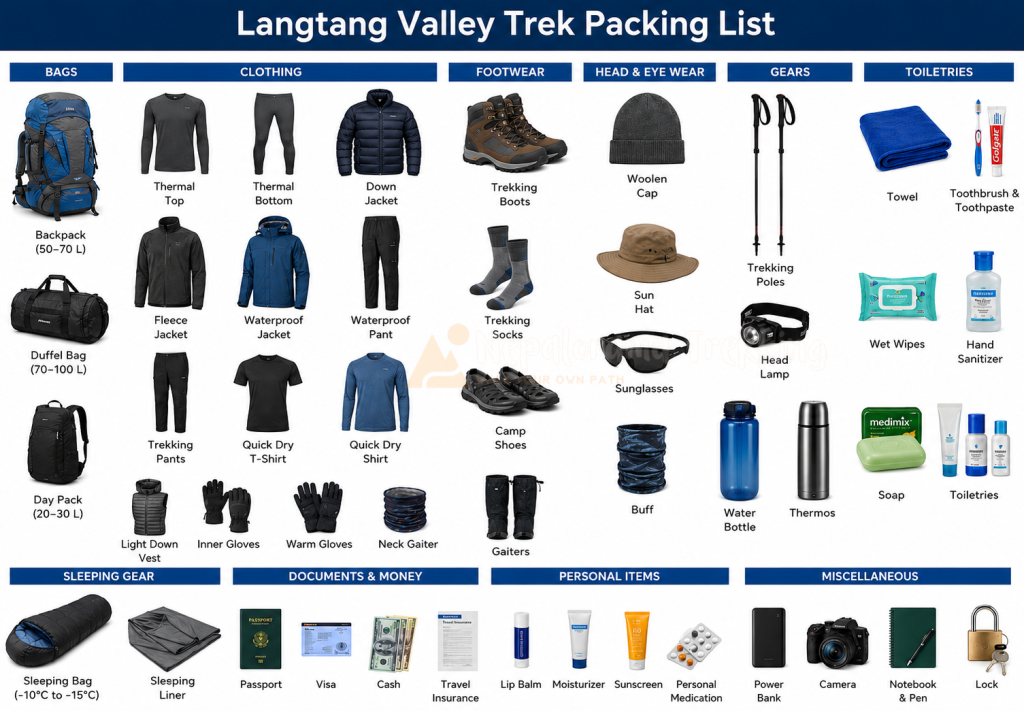
Clothing
Upper Body
- 2-3 moisture-wicking T-shirts
- 1 warm fleece Jacket
- 1 down Jacket( light and warm)
- 1 Waterproof and Windproof Jacket
- 1 thermal inner layer
Lower Body
- 2 Trekking pants
- 1 thermal Pant
- 1 rain Pant
- 2-3 underwear ( quick dry)
Head & hands
- warm woolen hat
- Sun hat/ cap
- Neck warmer / Buff
- Warms Gloves
- Lightweight Gloves
Footwear
- Strong Trekking Boots
- Lightweight Shoes/ Sandals for teahouse
- 3-4 woolen socks
- 1-2 pair light socks
Gear and Equipment for Langtang Valley Trek
- Trekking Poles
- Backpack 30-50L
- Rain Cover
- Sleeping Bag ( Good for -5 degree to – 10 degree Celsius)
- Water Bottle ( 2L total)
- Headlamp with extra batteries
- Sunglasses ( UV protection )
- Sunscreen ( SPF 30-50)
- Lip Balm
- Small Towel ( Quick dry)
Personal Hygiene Items for Langtang Valley Trek
- Toothbrush + Toothpaste
- Soap or body wipes
- Hand Sanitizer
- Toilet Paper
- Molisturizer
- Small Comb
- Deodorant ( Reduce/ Remove body Smell)
First Aid & Medicines for Langtang Valley Trek
- Diamox ( Forb altitude Sickness – only if needed
- Paracetamol
- Antiseptic Cream
- Oral rehydration salts
- Water Purification tablets
- Any Personal Medicine
Electronic
- Mobile phone
- Power bank ( 10,000 – 20,000 mah )
- Charging Cables
- Adapter ( Nepal type round pin)
- Camera + batteries ( Optional )
Document & Money
- TIMS Card
- Langtang National Park Permit
- Passport Copy
- Travel Insurance ( International Trekkers )
- Cash ( NPR )
Snack ( Optional but useful )
- Energy bars
- Chocolates
- Nuts
- Electrolyte Powder
Extras
- Gaiters ( if trekking in winter)
- Hot Bag
- Notebook/ Pen
- Lightweight book or Kindle
Altitude Sickness in Langtang Valley Trek:
Altitude sickness is one of the most important concerns for trekkers heading to the Langtang Valley. Although the trek is considered moderate, the elevation gain can still affect your body if you’re not prepared.
The Langtang Valley Trek starts from Syabrubesi (around 1,400 meters) and gradually climbs to Kyanjin Gompa (3,870 meters) and Tserko Ri (4,984 meters). At these altitudes, oxygen levels decrease, making acclimatization essential.
Common Symptoms of Altitude Sickness
- Headache and dizziness
- Nausea or vomiting
- Fatigue and weakness
- Loss of appetite
- Difficulty sleeping
These symptoms are early signs of Acute Mountain Sickness (AMS). If ignored, it can become serious.
How to Prevent Altitude Sickness
Prevention is always better than cure.
- Ascend slowly and follow a proper itinerary
- Stay hydrated (drink 3–4 liters of water daily)
- Avoid alcohol and smoking
- Take rest days for acclimatization
- Eat a balanced, high-energy diet
Many trekkers also carry Diamox, but it should only be used after consulting a doctor.
What to Do If Symptoms Worsen
If symptoms become severe:
- Stop ascending immediately
- Inform to guide
- Descend to a lower altitude
- Seek medical help if necessary
Why Book with Nepalorama Trekking
Nepalorama Trekking is one of the best trekking companies in Nepal, offering safe, authentic, and well-organized Himalayan adventures for travelers from around the world. Known for its experienced local guides, personalized service, and carefully designed itineraries, Nepalorama Trekking specializes in popular routes such as the Langtang Valley Trek, Manaslu Circuit Trek, and other Himalayan journeys in Nepal.
- Local Expertise
- Experienced local guides with deep knowledge of the Langtang region
- Well-planned trekking routes for better experience
- Rich cultural insights during the journey
- Quick and effective response to unexpected challenges
- Personalized Trekking Experience
- Focus on small groups for better attention
- Customized itineraries based on your time and fitness
- Suitable for both beginners and experienced trekkers
- Safety-First Approach
- Proper acclimatization schedules to prevent altitude sickness
- Trained guides with first aid knowledge
- Strong emergency response planning
- Transparent Pricing
- No hidden costs or surprise charges
- Clear breakdown of all expenses
- Includes permits, accommodation, food, and guide services
- Friendly & Professional Service
- Warm hospitality from start to finish
- Professional guidance throughout the trek
- Strong focus on customer satisfaction
Langtang Trek Difficulty: Fitness Level, Medical & Health Requirements
The Langtang Valley Trek is considered a moderate-level trek, making it suitable for both beginners and experienced trekkers with a reasonable level of fitness. To comfortably complete the trek, you should be able to walk for about 5–7 hours per day on varied terrain, including both uphill and downhill trails. Carrying a light backpack is also part of the daily routine. While you don’t need to be an athlete, having basic stamina and endurance will make your journey much more enjoyable.
From a health perspective, it is important to ensure that you do not have any serious heart or lung conditions before starting the trek. If you have any medical concerns, it is highly recommended to consult a doctor in advance. Carrying your personal medication, along with a basic first aid kit, is also essential for safety during the trek.
To prepare physically, you should focus on building your endurance and strength a few weeks before your trip. Engaging in cardio exercises such as running, cycling, or brisk walking can help improve your stamina. Practicing hikes on uneven terrain will give you a better idea of trail conditions, while strengthening your legs will make uphill climbs easier. With proper preparation and a steady pace, even first-time trekkers can successfully complete the Langtang Valley Trek and enjoy its incredible natural beauty.
Langtang Trek Weather & Temperature Guide (Best Time to Go)
Spring in Nepal, from March to May, is widely regarded as one of the finest periods to explore the Langtang Valley. During these months, the weather is usually clear and stable, offering excellent mountain views and pleasant trekking conditions. The trails come alive with blooming rhododendrons and fresh greenery, creating a colorful and vibrant atmosphere. While daytime temperatures in higher elevations generally range between 10°C and 15°C, nights can still be cold, often dropping to around -5°C to -8°C. As the season progresses toward late May, the temperature becomes milder, making the trek even more comfortable.
Another highly recommended time for the Langtang trek is the autumn season, which spans from September to November. Following the monsoon rains, the air becomes fresh and dust-free, resulting in crystal-clear views of the surrounding Himalayan peaks. The weather during this period is dry and stable, making it ideal for trekking. Daytime temperatures remain moderate, usually between 10°C and 15°C, which is perfect for long walking days. In addition, this season coincides with major Nepalese festivals, giving trekkers a chance to experience local traditions and cultural celebrations along the trail.
The summer or monsoon season, from mid-June to August, brings frequent rainfall to the Langtang region. Trails can become muddy and slippery, and cloud cover often limits mountain visibility. However, the landscape turns lush and green, and the trekking routes are much quieter due to fewer visitors. Winter, from December to February, is the coldest time of year. Temperatures drop significantly, especially at higher altitudes such as Langtang Village and Kyanjin Gompa, where nighttime temperatures can fall below -10°C. Snowfall is common during this period, which can make trekking more demanding but also offers stunning snow-covered scenery.
Langtang Trek in Monsoon: Is It Worth It?
Trekking the Langtang Valley during the monsoon season is less popular compared to spring and autumn, but it is still possible for adventurous travelers who don’t mind rain and changing trail conditions. This period offers a very different experience of the Himalayas, with its own unique beauty and challenges.
One of the biggest advantages of trekking in the monsoon is the peaceful environment. Since fewer trekkers visit during this time, the trails are quiet and less crowded, allowing you to enjoy a more personal and calm journey. The entire valley becomes lush and green due to continuous rainfall, making the landscapes incredibly vibrant and refreshing. Waterfalls are fuller, forests are dense, and the overall scenery feels alive and untouched.
However, monsoon trekking also comes with certain difficulties. Trails can become slippery and muddy, especially in forested and lower elevation areas. Leeches are common during this season, which can be uncomfortable for some trekkers. In addition, heavy cloud cover often blocks mountain views, meaning you may not always get clear visibility of the Himalayas.
Despite these challenges, monsoon trekking in Langtang is ideal for those who prefer solitude, enjoy natural greenery, and don’t mind occasional rain. With proper preparation, good trekking gear, and a flexible mindset, it can still be a rewarding and memorable Himalayan experience.
Langtang Trek Safety: Risk Level, Death Rate & Langtang Lirung Climbing Facts
The Langtang Valley Trek is generally considered one of the safer trekking routes in Nepal, especially when compared to more remote or technical expeditions. Thousands of trekkers complete this route every year without major issues, particularly when they follow proper guidance, pacing, and safety measures. The overall risk level is low to moderate, and most incidents occur due to altitude sickness, poor preparation, or ignoring weather conditions rather than the trail itself.
Is Langtang Dangerous?
Langtang is not considered a dangerous trek for well-prepared travelers. The trail is well-established, and teahouse facilities are available throughout most of the route. With a proper itinerary and gradual ascent, most trekkers complete the journey safely. The key factor is not the difficulty of the region but how well you prepare and how carefully you follow safety guidelines during the trek.
Langtang Lirung Climbing Facts
Langtang Lirung, standing at 7,227 meters, is the highest peak in the Langtang region. It is a technical mountaineering peak that requires advanced climbing skills, equipment, and experience. It is important to understand that Langtang Lirung is not part of the standard Langtang Valley Trek route and should only be attempted by professional climbers with proper permits and expedition support.
Safety Tips for Langtang Trek
To ensure a safe and enjoyable trekking experience, it is important to follow basic safety practices:
- Always trek with an experienced guide or trekking company
- Pay attention to early symptoms of altitude sickness and act quickly if they appear
- Stay updated on weather forecasts and avoid risky conditions
- Maintain a slow and steady walking pace to allow proper acclimatization
Communication on Langtang Trek: Network & Internet Guide
Staying connected during the Langtang Valley Trek is possible, but it becomes increasingly limited as you move to higher altitudes. In the lower sections of the trail, communication is relatively easier, but as you ascend toward Langtang Village and Kyanjin Gompa, network coverage becomes weaker and less reliable.
Mobile Network Coverage
In most parts of the Langtang region, Nepal Telecom (NTC) generally provides better coverage compared to Ncell. However, even with NTC, the signal strength is not consistent. You may get decent connectivity in lower villages like Syabrubesi and Lama Hotel, but the signal often becomes weak or completely unavailable in higher elevations. Therefore, it is not advisable to rely fully on mobile networks for continuous communication during the trek.
Internet Access on the Trail
Wi-Fi is available in many teahouses along the Langtang route, but it is usually paid and can be expensive depending on the altitude. The internet speed is often slow and unstable due to remote geography and weather conditions. It is suitable for basic messaging or quick updates, but not for heavy browsing or video calls.
Important Communication Advice
Since connectivity is unpredictable, it is strongly recommended to inform your family or friends in advance that you may be offline for several days during the trek. This helps avoid unnecessary worry and ensures better planning for communication gaps.
Local Dress & Lifestyle in Langtang Region
The Langtang Valley is primarily inhabited by the Tamang community, one of the most culturally rich ethnic groups in Nepal. Their lifestyle, traditions, and clothing reflect a strong connection to the mountains, Tibetan Buddhism, and simple rural living. Trekking through this region offers a unique opportunity to experience authentic Langtang culture up close.
Traditional Clothing
The local people of Langtang wear clothing designed to suit the cold mountain environment. Woolen garments are commonly used to keep warm during harsh winters, especially in higher villages. Many of these clothes are handwoven or locally made, reflecting traditional craftsmanship passed down through generations. In addition, handmade accessories such as scarves, belts, and jewelry are often worn, which carry cultural and spiritual significance.
Lifestyle in Langtang
The lifestyle of the Tamang community is mostly based on agriculture and livestock. People grow seasonal crops, raise yaks, and depend on natural resources for their daily needs. Life here is simple and closely connected to nature. Buddhism plays a strong role in daily life, and you will notice monasteries, prayer flags, mani walls, and spinning prayer wheels throughout the villages.
How Much Cash Should You Carry for Langtang Trek?
Cash planning is essential.
| Category | Details | Notes |
| Extra Daily Expenses | Snacks, beverages (tea, coffee, chocolate), bottled water, personal shopping | Not included in most trekking packages |
| Tipping | Recommended around 10% of total trek cost for guides and porters | Based on service quality and appreciation |
| Hot Shower & Hot Water | Charged separately in teahouses | Prices increase at higher altitudes |
| Wi-Fi & Internet | Paid Wi-Fi available in most teahouses | Slow and less reliable in higher regions |
| Charging Devices | Paid charging for phones, cameras, power banks | Costs increase as altitude rises |
| Cultural Expenses | Donations at monasteries and temples | Optional but culturally appreciated |
| Gear Replacement | Buying or replacing forgotten/damaged trekking gear | Available in lower villages, limited options higher up |
| Daily Budget | Average $15–20 per day | Can increase depending on personal comfort level |
Extending the Langtang Trek: Best Add-On Routes
You can extend your trek for a richer experience.
Gosaikunda Lake Trek
The Gosaikunda Lake extension is one of the most popular add-ons to the Langtang Valley Trek. This sacred alpine lake, located at high altitude, holds deep religious significance for both Hindus and Buddhists. The trail takes you through beautiful forests, rugged landscapes, and high mountain terrain before reaching the stunning glacial lakes surrounded by snow-covered peaks. It is an excellent choice for trekkers seeking both natural beauty and spiritual experience.
Helambu Trek
The Helambu region offers a peaceful and culturally rich extension to the Langtang area. Known for its lower altitude and pleasant climate, this trail passes through traditional Sherpa and Hyolmo villages. Trekkers can enjoy terraced fields, monasteries, and friendly local hospitality. It is less crowded compared to other trekking routes, making it ideal for those looking for a calm and cultural trekking experience after Langtang.
Tamang Heritage Trail
The Tamang Heritage Trail is a perfect cultural extension that showcases the lifestyle, traditions, and history of the Tamang community. The route goes through remote villages where trekkers can experience traditional houses, local customs, hot springs, and panoramic views of the Langtang Himal range. This trail is ideal for those who want to deeply connect with local culture while enjoying scenic Himalayan landscapes.
Electricity & Charging on Langtang Trek
Electricity is available along the Langtang Valley Trek, but it becomes more limited and less reliable as you move toward higher elevations. In lower villages, power supply is relatively stable, while in higher regions it often depends on solar energy and local backup systems.
- Charging electronic devices such as phones, cameras, and power banks usually costs extra in teahouses
- In higher altitude villages, electricity is mostly generated through solar power, so availability can be limited depending on weather conditions
- It is highly recommended to carry a fully charged power bank or portable charger to avoid inconvenience during the trek
Culture & Festivals of Langtang Region
The Langtang region is deeply rich in culture, strongly influenced by Tibetan Buddhism and the traditions of the local Tamang community. Trekking through this area is not only a natural experience but also a cultural journey where you can witness ancient customs, spiritual practices, and warm Himalayan hospitality.
Cultural Highlights
- The region is home to many Buddhist monasteries, where monks continue traditional rituals and daily prayers
- Colorful prayer flags can be seen throughout the trail, symbolizing peace, compassion, and blessings for travelers
- Mani walls, chortens, and prayer wheels are commonly found along villages and paths, reflecting deep spiritual beliefs
Festivals in Langtang
- One of the most important festivals celebrated in the region is Losar, the Tibetan New Year, marked with traditional music, dances, prayers, and family gatherings
- Other local Buddhist festivals are also celebrated throughout the year, depending on the lunar calendar
- During festivals, villages become lively with cultural performances and religious ceremonies
Cultural Experience for Trekkers
While trekking in Langtang, you will experience a unique blend of Tibetan and Tamang culture. From monasteries on hilltops to traditional stone houses and friendly local interactions, every part of the journey offers a deeper understanding of Himalayan life. This cultural richness makes the Langtang Valley Trek not only scenic but also deeply meaningful and memorable.
Nepal Tourist Visa Guide for Langtang Trek
Getting a Nepal tourist visa is simple and hassle-free for travelers coming to trek in the Langtang Valley. Most visitors can obtain a visa on arrival at Tribhuvan International Airport in Kathmandu or apply online in advance through the official e-visa system. Both options are easy and widely used by trekkers.
The visa fee depends on the duration of stay. A 15-day visa costs around $30 USD, while a 30-day visa costs approximately $50 USD. For longer travel plans, a 90-day visa is also available at a higher cost. Travelers must have a passport valid for at least six months from the date of entry into Nepal.
Overall, the Nepal visa process is quick and straightforward, making it easy for trekkers to focus on planning their Langtang adventure without any major paperwork difficulties.
Langtang Trek for Beginners: Complete Guide
The Langtang Valley Trek in Nepal is one of the best options for first-time trekkers who want to experience the Himalayas without extreme difficulty. It is widely recommended as a beginner-friendly trekking route in Nepal because it offers a perfect balance of adventure, culture, and manageable trekking conditions.
Why Langtang Trek is Perfect for Beginners
- Short Duration: The Langtang trek usually takes around 7–10 days, making it ideal for travelers with limited time
- Moderate Difficulty: It is a moderate level trek in Nepal, requiring basic fitness but no technical climbing skills
- Less Crowded Trails: Compared to Everest and Annapurna, the Langtang Valley trekking route is quieter and more peaceful, offering a more personal experience
Customized Langtang Trek Itinerary
The Langtang Valley Trek itinerary for 2026/2027 can be fully customized depending on your travel time, fitness level, and personal interests. Whether you are a beginner looking for a shorter journey or an experienced trekker wanting a longer Himalayan experience, flexible trekking plans can be designed to suit your needs.
A standard Langtang itinerary usually takes around 7 to 10 days, but it can be adjusted by adding extra acclimatization days, cultural exploration, or side trips to nearby attractions such as Kyanjin Ri or Tserko Ri for panoramic mountain views. Some trekkers also extend their journey to include Gosaikunda Lake or the Helambu region for a richer experience.
With a customized Langtang trek package, you can choose your own pace, rest days, and level of comfort. This flexibility makes the Langtang region ideal for families, beginners, and private groups who want a personalized Himalayan adventure. A well-planned itinerary ensures better acclimatization, improved safety, and a more enjoyable trekking experience in the beautiful Langtang Valley.
Langtang Trek Travel Insurance Guide
Travel insurance is highly recommended for the Langtang Valley Trek in Nepal, as it ensures your safety and financial protection during the journey. Trekking in the Himalayas involves high altitude travel, remote areas, and unpredictable weather conditions, so having proper insurance gives you peace of mind throughout the trip.
Your insurance policy should specifically cover high-altitude trekking, ideally up to at least 5,000 meters, since popular viewpoints like Tserko Ri reach high elevations. It is also very important that your insurance includes emergency helicopter evacuation, as this is the fastest way to reach medical care in case of serious altitude sickness, injury, or other emergencies in remote areas.
In addition to these key coverages, your insurance should also include medical treatment, trip cancellation, and loss of personal belongings. Before starting your trek, always check the policy details carefully to ensure it fully covers trekking activities in Nepal.
Famous Places and Villages in Langtang Valley Trek
- Bamboo
- Rimche
- Ghoda- Tabela
- Langtang Village
- Kyanjin Gompa
- Kyanjin Ri
- Tserko-Ri

Bamboo
Bamboo is one of the most popular and peaceful stops on the Langtang Valley Trek. It lies between Syabrubesi and Lama Hotel, inside the beautiful Langtang National Park. Many trekkers search for this place because it is known for its dense bamboo forest, red panda habitat, and riverside walking trail.
The trail from Syabrubesi to Bamboo is easy and perfect for beginners. You walk through green forests, waterfalls, and the bank of the Langtang Khola. Bamboo is also famous for its teahouses, where trekkers take lunch or rest before going to Lama Hotel.
This area is rich in wildlife. You can sometimes see monkeys, Himalayan birds, and if lucky, the rare red panda. Because of the thick forest and cool climate, Bamboo feels fresh and calm throughout the year.
Bamboo is an important landmark for trekkers because it is the first major stop on the Langtang Valley trekking route and a key point on the Syabrubesi to Langtang village trail.

Rimche
Rimche Village is a small and quiet settlement located between Bamboo and Lama Hotel on the Langtang Valley Trek. Many trekkers stop here to rest and enjoy the beautiful mountain forest views. The village sits on a steep hillside, offering an excellent view of the Langtang Khola river flowing far below.
The trail from Bamboo to Rimche is short but a bit steep, filled with green forest, waterfalls, and fresh mountain air. Rimche has a few teahouses where trekkers can relax, eat lunch, or stay overnight. The peaceful environment makes it a perfect place to take a break before continuing to Lama Hotel.
This area is also known for wildlife such as monkeys, deer, Himalayan birds, and sometimes even red pandas. Due to fewer tourists, Rimche feels natural, quiet, and very refreshing.
Rimche is a simple village, but its location on the Langtang trek route makes it an important stop for trekkers walking toward Langtang Village, Kyanjin Gompa, and Kyanjin Ri.

Ghoda- Tabela
Ghoda Tabela is one of the most beautiful and open areas on the Langtang Valley Trek. It comes after Lama Hotel and Rimche, and before Langtang Village. Trekkers love this place because the forest opens into a wide valley with stunning views of Langtang Lirung and other snow-covered peaks.
The name “Ghoda Tabela” means “Horse Stable”, because in the past, this area was used for keeping horses. Today, it is known for its army checkpost, where trekking permits are checked. The trail here becomes easier and more scenic, with wide meadows, yak grazing fields, and fresh mountain breeze.
This area is very peaceful and surrounded by pine and rhododendron forests. The walk from Lama Hotel to Ghoda Tabela is gradual, and many trekkers stop here for lunch because the views are perfect. You can often see yaks, horses, and sometimes Himalayan birds along the way.
Ghoda Tabela is an important point on the Syabrubesi to Kyanjin Gompa route, and many trekkers feel that this is where the real beauty of the Langtang Valley begins.

Langtang Village
Langtang Village is the main settlement in the Langtang Valley, located after Ghoda Tabela on the trekking route. It is a small traditional Tamang village surrounded by snow-capped peaks like Langtang Lirung and lush green forests. The village is famous for its local culture, homestays, and hospitality, making it a favorite stop for trekkers.
Langtang Village was heavily affected by the 2015 earthquake, but it has been beautifully rebuilt while keeping its traditional charm. Trekkers can enjoy local food, interact with villagers, and experience Tamang culture and traditions.
The village also serves as a base for hikes to Kyanjin Gompa, Tsergo Ri, and other nearby peaks. It offers a perfect mix of natural beauty, cultural experience, and adventure, making it one of the most searched destinations in Langtang Valley Trek.

Kyanjin Gompa
Kyanjin Gompa is a famous stop on the Langtang Valley Trek, located above Langtang Village. It is well-known for its ancient Buddhist monastery, stunning mountain views, and cheese factory. Trekkers come here to experience peaceful surroundings, Tamang culture, and the breathtaking view of Langtang Lirung and nearby peaks.
Kyanjin Gompa is also a base for hiking to Tsergo Ri, Kyanjin Ri, and surrounding glaciers. The village is small but has comfortable teahouses where trekkers can rest, eat, and enjoy the mountain scenery. The monastery adds a spiritual touch to the trekking experience, making it one of the most visited places in Langtang Valley.
Trekkers often spend 1–2 days here to explore the hiking trails, cheese factory, and panoramic viewpoints, making it a highlight of the Syabrubesi to Langtang Valley Trek.

Kyanjin Ri
Kyanjin Ri is a popular hiking destination above Kyanjin Gompa on the Langtang Valley Trek. It is famous for its panoramic views of Langtang Lirung, Langshisha Himal, and surrounding snow-covered peaks. Trekkers often climb Kyanjin Ri early in the morning to watch the sunrise over the mountains.
The hike to Kyanjin Ri is moderately challenging, taking around 3–4 hours from Kyanjin Gompa. The trail passes through rocky slopes, moraine, and small streams, offering amazing photography opportunities. From the top, trekkers can see the entire Langtang Valley, nearby glaciers, and sometimes wildlife like Himalayan birds and marmots.
Kyanjin Ri is a must-visit for trekkers who want to experience breathtaking mountain views, making it one of the highlight stops in Langtang Valley Trek.

Tserko-Ri
Tsergo Ri is a stunning viewpoint near Kyanjin Gompa on the Langtang Valley Trek. It is famous for offering 360-degree views of the Langtang Lirung, Langshisha Himal, Gosainkunda Lake (distant view), and the entire Langtang Valley. Trekkers often hike to Tsergo Ri to capture the sunrise or sunset over the mountains.
The hike to Tsergo Ri is moderately difficult and takes about 4–5 hours round trip from Kyanjin Gompa. The trail passes through rocky terrain, small streams, and open alpine slopes, giving trekkers an adventurous experience.
Tsergo Ri is also known for its snow-covered peaks in winter, wildflowers in spring, and occasional sightings of Himalayan wildlife. It is one of the most beautiful and rewarding hikes in Langtang Valley, making it a favorite among trekkers and photographers.
Langtang Trek Cost
Book this 10-day private trek for 2 from just USD $575 per person. Ask us for a quote for larger groups.
We calculate the exact cost of your trip package based on your customised travel plan and the number of people trekking. This way, you only pay for what you want and if you prefer, you can choose to make some of your own arrangements – like city hotels.
Ask for a quote today with no obligation to book!
As standard, our quotes include and exclude the following. Our Langtang Valley Trek package cost is carefully designed to cover all essential services. However, when we provide a quote we’ll explain exactly what is and isn’t included in the cost, based on your customised itinerary.
| No of Pax | Cost | INQUERY |
| 1 pax | USD 590 | SEND INQUERY |
| 2-4 pax | USD 575 | SEND INQUERY |
| 5-10 pax | USD 545 | SEND INQUERY |
If more than 10 people are in the group, please contact us for a special group offer on WhatsApp.
What's Included
- Transfers from and to Kathmandu International Airport
- Tourist bus from Kathmandu to Syabrubesi to Kathmandu (optional for an extra cost: private jeep transfers)
- Excellent 3* hotel shared accommodation (twin or triple share) in Kathmandu with breakfast (optional for an extra cost: choose to stay in a luxury city hotel)
- Shared accommodation in teahouses (usually 2 people per room) during the trek
- All meals during the trek – choose a standard option from the menu at breakfast, lunch and dinner.
- Experienced and friendly English-speaking Guide; their salary, accommodation, meals and insurance
- Trekking permits
- Government taxes
- Trek route map and completion certificate
What's not Included
- All tea, coffee,mineral water (we recommend water purification tablets), and bar bills (coke, juice, beer, etc.)
- International airfare
- Travel insurance
- Nepal entry visa fees
- Tips for guides and porters
Optional Add-ons for Your Langtang Valley Trek
Make your Langtang Valley Trek more comfortable and flexible with these optional services from Nepalorama Trekking. You can choose any option based on your needs.
Porter Service – USD 160
If you don’t want to carry your heavy bag, you can hire a porter. The porter will carry your luggage so you can walk easily and enjoy the trek. One porter can carry up to 25 kg and can be shared by two trekkers.
Private Jeep from Kathmandu to Syabrubesi – USD 150
Instead of using a local bus, you can travel in a private jeep from Kathmandu to Syabrubesi (the trek starting point). The jeep is more comfortable and faster. One jeep can carry 5–6 people.
Private Jeep from Syabrubesi to Kathmandu – USD 150
After finishing the trek, you can return to Kathmandu by private jeep for a smooth and comfortable ride. Each jeep can carry 5–6 passengers.
Langtang Valley Trek Image Gallery


FAQ for Langtang Valley Trek
What is the Langtang Valley Trek?
The Langtang Valley Trek is one of the most beautiful and culturally rich trekking routes in Nepal, with the ideal combination of natural beauty, traditional culture and high Himalayan adventure, situated smack in the middle of Langtang National Park, the trek leads adventurers through sprawling forests of rhododendron, oak and bamboo, across shimmering rivers and waterfalls, up into glacial inner valleys formed and carved from the slow passage of time. Along the way, trekkers stroll through genuine Tamang villages, whose residents still have a strong Tibetan-Buddhist heritage, as seen in their lifestyles, constructions, clothing and religious ceremonies. There are prayer flags flying over stone chortens and mani walls, ancient monasteries like Kyanjin Gompa that welcome the visitor in an atmosphere of ease and spirituality. Rising higher into the mountains, we are treated to breathtaking views of enormous mountains that surround us, like Langtang Lirung (7,227m), Dorje Lakpa and Yala Peak that unveil themselves around every corner, providing perfect photographic moments at every turn. Compared to the more popular treks of Everest and Annapurna, the Langtang Valley trek is relatively less populated, and provided a much more serene experience for trekkers, who may prefer less interaction with trekkers, spontaneity and opportunities to connect with nature and culture.
How long does the Langtang Valley Trek take?
Langtang Valley Treks will take between 7 and 10 days. Most treks vary in length depending on where you start, your pace, the specific itinerary, and interest in side trips. Most treks start in Syabrubesi (or occasionally, Syabru), which is a roadside village that you can reach by road from Kathmandu, and then you gradually climb to Kyanjin Gompa (the highest and most popular overnight stop in the trek above sea level) through scenic forests, riverbanks, and traditional Tamang villages. The majority of trekkers appreciate spending an extra day or two in Kyanjin to hike the ridges nearby at Kyanjin Ri (4,773m) or alternative, higher one, Tsergo Ri (4,984m) for panoramic views of the majestic Himalayan mountains. You can also continue trekking further for acclimatization or to have a cultural experience of restful mountain towns. Some trekkers shorten the trek, and some prefer to take it a little slower to have some extra rest days to embrace the natural beauty and cultural treasures of the Langtang area.
What is the best time to do the Langtang Valley Trek?
The Langtang Valley Trek has to be undertaken during the spring (March to May) and autumn (September to November) seasons because these seasons offer the best weather for the Langtang trek. During the spring, you have the opportunity to enjoy the lovely colours of flowering rhododendron forest, dense green forest, and wildflowers that bloom in this season. Moderate and pleasant temperatures are in the lower and mid sections of the trail, and upper sections of the trail offer stunning views of snow covered Himalayan peaks under clear blue skies. Autumn, or post-monsoon, will have the best and most unobstructed mountain views throughout the year. These trekking months are peak season, but you will still see a lot fewer trekkers than on more established treks in Nepal. Winter (December to February) also can be quite a peaceful time to visit and enjoy the lonely trails and the majestic icy landscapes, if you are an experienced and cold-acclimatized trekker. Monsoon (June to August) is the worst time to trek as it is marred by heavy rains, soggy trails with leeches, and cloud-shrouded mountains that obstruct scenery as much as increase the probability of landslide.
Is the Langtang Valley Trek suitable for beginners?
Yes, the Langtang Valley Trek is one of the best options for beginner trekkers in Nepal. It is moderately difficult, with well-marked trails and reasonable daily ascents. However, basic fitness and some hiking experience are still recommended due to the altitude and terrain. Certainly, the Langtang Valley Trek is well-known as one of the best treks in Nepal for beginners wanting to enjoy the Himalayas at a subdued level of altitude and technicality. This trek is considered to be moderate in level, but you will receive a challenging and rewarding trek that is moderate for persons with a reasonably fit level, in good health, and a good attitude. The hike on the trails is reasonably well mapped and clearly defined, whether the walk is in a gradual ascent up the valley, through the quiet beauty of woodland, villages and settlements to the alpine meadows, all set a backdrop to a great trekking experience that is well within reach. The level of walking along the trails in also considered moderate, typically it will consist of 5 to 7 hours per day of walking, and the ample rest and acclimatization through the trek. The maximum altitude of trekking for this trek is above 3800 meters (Kyanjin Gompa), as well as optional side treks with increased altitudes to 4984 meters (Tsergo Ri). In regards to level of overall fitness, we highly suggest some hiking experience because altitude can be difficult as first-timer.
Do I need a guide for the Langtang Valley Trek?
While it is possible to do the Langtang Valley Trek independently, hiring a guide can greatly enhance your experience. A local guide provides safety, cultural insights, and navigation assistance, especially after the 2015 earthquake, which affected parts of the trail. Many trekkers also hire a porter to ease the physical burden.
What permits are required for the Langtang Valley Trek?
Trekkers need two permits for the Langtang Valley Trek:
Langtang National Park Entry Permit
Trekker’s Information Management System (TIMS) Card
What kind of accommodation is available on the Langtang Valley Trek?
The lodges you will stay at on the Langtang Valley Trek are teahouse-style accommodation and provide basic comforts. They are simple lodges operated by local Tamang families, and they are typically twin shared with basic bedding in rooms, so bringing a sleeping bag is best for extra warmth. Bathrooms are shared, and for a small fee, you may have access to hot showers, Wi-Fi, and charging. Dining areas are communal, where you can enjoy meals and get warm with fellow trekkers. The facilities are basic, but the hospitality of the locals is personal and friendly, which adds to the experience.
How do I get to the starting point of the Langtang Valley Trek?
The trek typically starts from Syabrubesi, which is about a 6–8 hour drive from Kathmandu by local bus or private jeep. The road is rough and winding but offers scenic views of rural Nepal and the Himalayas en route.
What is the maximum altitude of the Langtang Valley Trek?
The highest point of the Langtang Valley Trek is usually Kyanjin Ri (4,773 meters) or Tsergo Ri (4,984 meters) if you do the side hikes. Most trekkers stay overnight in Kyanjin Gompa (3,870 meters) before attempting the viewpoints for stunning Himalayan panoramas.
Is altitude sickness a concern on the Langtang Valley Trek?
Yes, altitude sickness is a potential risk on the Langtang Valley Trek, especially after 3,000 meters. Trekkers should ascend slowly, stay hydrated, and allow time for acclimatization. Symptoms include headache, nausea, and dizziness. Always consult your guide or descend if symptoms worsen.
What kind of food is available during the Langtang Valley Trek?
Teahouses along the Langtang Valley Trek serve a variety of meals including Nepali dal bhat, Tibetan bread, noodles, pasta, soups, and momos. The food is vegetarian-friendly, and clean drinking water is available through boiled or filtered options.
Is the Langtang Valley Trek safe after the 2015 earthquake?
Yes, the Langtang Valley Trek has been reopened and is considered safe. The trail and infrastructure have been rebuilt, and local communities are actively welcoming trekkers again. Trekking here also supports the economic recovery of the region.
Can I charge my devices during the Langtang Valley Trek?
Most teahouses on the Langtang Valley Trek offer charging facilities for a small fee. However, power can be limited, so it’s advisable to bring a power bank or solar charger. Charging options become more scarce the higher you go.
What makes the Langtang Valley Trek unique compared to other treks in Nepal?
The Langtang Valley Trek offers a perfect blend of natural beauty, Tamang culture, and high-altitude adventure, all within a shorter time frame and close proximity to Kathmandu. It is less commercialized than the Everest or Annapurna regions, offering a more peaceful and intimate trekking experience.
What should I pack for the Langtang Valley Trek?
For the Langtang Valley Trek, you should pack layered clothing, a warm sleeping bag, trekking boots, rain gear, personal medication, headlamp, water purifier or tablets, trekking poles, and snacks. Weather can be unpredictable, so pack for both cold and warm conditions.
Can I see wildlife on the Langtang Valley Trek?
Yes, the Langtang Valley Trek takes you through Langtang National Park, home to diverse flora and fauna. You may spot red pandas, Himalayan tahrs, langurs, musk deer, and a variety of birds. The region is rich in biodiversity and nature lovers will find it rewarding.
Are there any cultural highlights on the Langtang Valley Trek?
Absolutely. The Langtang Valley Trek passes through several Tamang and Tibetan-influenced villages. Cultural highlights include Gompas (monasteries), mani walls, chortens, and traditional homes. A visit to Kyanjin Gompa provides insight into the spiritual practices of the local people.
What are some side trips during the Langtang Valley Trek?
Popular side trips from the main Langtang Valley Trek route include:
Kyanjin Ri for sunrise views
Tsergo Ri for a challenging hike and 360-degree mountain panorama
Langshisha Kharka, a remote pasture for a longer day hike
These add adventure and additional rewards for those with extra time and energy.
How much does the Langtang Valley Trek cost?
The cost of the Langtang Valley Trek varies but generally ranges between $500 to $900 USD, depending on the length of the trek, whether you hire a guide/porter, and your choice of transportation and accommodation. Budget trekkers can keep costs low by traveling independently, while guided treks offer more comfort and safety.
How can I download an offline map for the Langtang Valley Trek?

You can download an offline map for the Langtang Valley Trek using mobile apps like Maps.me, AllTrails, Gaia GPS, or FarOut (formerly Guthook). Simply install the app, search for the Langtang Valley region, and download the map while you have internet access. These apps show trails, villages, altitudes, and waypoints—even without a mobile signal.
What can I expect from the Langtang Valley Adventure Trek?
The Langtang Valley Adventure Trek offers a perfect mix of thrilling mountain trails, rich cultural experiences, and breathtaking Himalayan scenery. This trek takes you deep into the Langtang National Park, where you’ll pass through dense forests, roaring rivers, and traditional Tamang villages before reaching the stunning alpine valley of Kyanjin Gompa. Along the way, you’ll enjoy close-up views of peaks like Langtang Lirung, explore ancient monasteries, and have the option to hike to scenic viewpoints like Kyanjin Ri or Tsergo Ri. It’s a moderate trek, ideal for adventure seekers looking for both natural beauty and cultural depth without the heavy crowds found in other regions like Everest or Annapurna.
Is the Langtang Valley Short Trek suitable for a limited travel schedule?
Yes, the Langtang Valley Short Trek is an excellent option for trekkers with limited time who still want to experience the beauty of the Himalayas. This condensed version of the full trek can be completed in 5 to 7 days, offering stunning mountain views, charming Tamang villages, and the chance to visit highlights like Kyanjin Gompa and Kyanjin Ri. It’s a perfect short adventure that doesn’t compromise on natural beauty or cultural experience.
What Our Travelers Say
Discover the amazing experiences shared by our travelers.
Unforgettable Langtang Valley Trekking Experience: Expert Guides and Unmatched Hospitality with Nepalorama Trekking
I and my boyfriend have joined the 8-days Langtang Valley trekking trip in late March with the help from Anna and Krishna. Krishna is very helpful to us for the trekking preparation as well as some tourist information about sightseeing in Kathmandu. During the 8 days trekking journey, we are really grateful and happy to have Bibek as our guide and Shiva as our porter. Bibek is a very experienced and friendly and knowledgeable guide that he took really good care of us during the whole journey. He would always try his best to fulfill our request and always make...
Read MoreHeartfelt Thanks to Nepalorama: A Wonderful Experience with Bouddhi and Krishna’s Support
I can only say a big thank you to the whole Nepalorama team and especially to Bouddhi and Krishna! They assisted us with great flexibility and sympathy in every moment, even and especially in the difficult ones. Thank you from the bottom of my heart. Daniele.
Read MoreExceptional Trekking Experience with Nepalorama: Professional, Friendly, and Always by Our Side!
Highly recommended! Sympathy, friendliness, maximum availability and professionalism are their strong points. We had a few problems during our trek which they immediately resolved with the utmost flexibility, facilitating all our requests without discussion, in fact they took great care, always remaining by our side. I will keep great memories of all of them and they will surely be my reference point for the near future in Nepal. Thank you very much for everything!
Read MoreA Wonderful Trek in Nepal with Krishna and the Nepalorama Team
I and my friend did Langtang Trek in Oct – Nov 2022 with Krishna and his team. It was my first time trekking in Nepal Himalayas, and everything was fantastic. Krishna and his team were warm and friendly while staying professional. All the arrangements followed the given program, and Krishna explained the schedule for next day to us every after dinner. The accommodations were well sorted. Besides the breathtakingly beautiful scenery, I enjoyed local culture and history told by Krishna. Before leaving for Nepal, Anna helped us organize the trip and answered all of our questions. Thank you Krishna, Anna...
Read MoreUnforgettable Langtang Valley Trek: Exceptional Service and Care with Bibek and Nepalorama Team
A group of us trekked to Langtang valley with Bibek from 26 September to 4 October 2022. This trip was my first time in Nepal, so I was quite worried about the food, and accommodation but Nepalorama organized the best things for us. During trekking, they booked hotels that provided a hot shower, and some nights also had an en-suite bathroom. Eating, we can choose whatever we want from the menu freely, and they provided fruits (apple and pomegranate) after dinner every day! Bibek and 2 porters took care of us extremely well, I was really happy with this wonderful...
Read MoreAssociation


